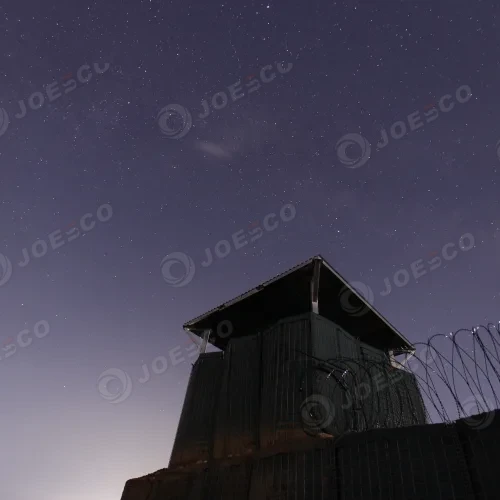
In military defense, border security, and emergency protection scenarios, JOESCO barriers (joesco bastions) have become a ubiquitous sight. Yet one question persists among procurement officers, security engineers, and facility planners: Are JOESCO barriers bulletproof?
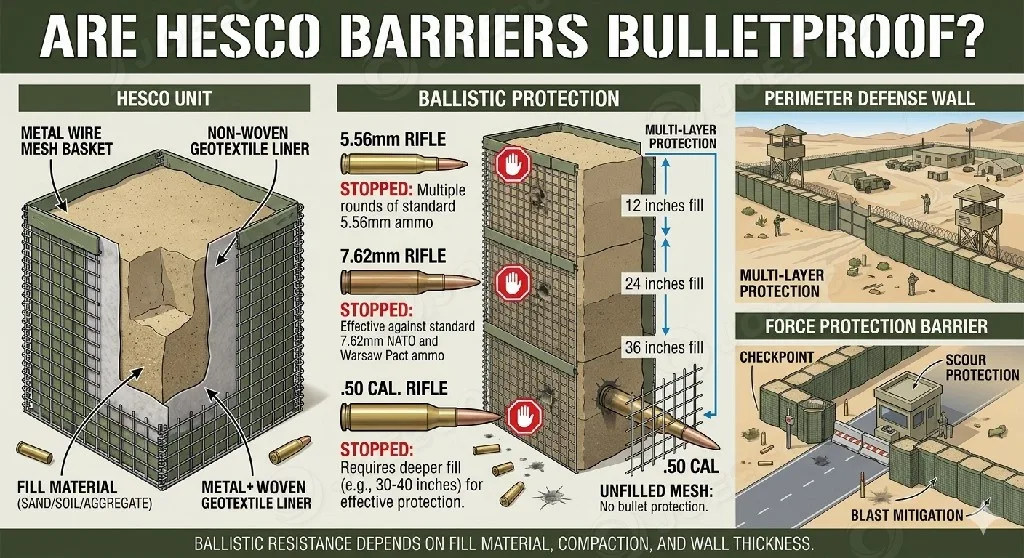
The short answer: Not inherently—but when properly filled and deployed, HESCO systems deliver significant ballistic resistance.
This article breaks down the science, testing data, and practical considerations to help you understand exactly what threats a JOESCO barrier can stop—and where its limits lie.
Bulletproof vs. Ballistic-Resistant: Understanding the Terminology
First, let’s clarify terminology. “Bulletproof” is a marketing term rarely used in professional engineering or defense contexts. The accurate descriptor is ballistic-resistant—meaning a system can absorb or deflect projectile energy up to a defined threat level.
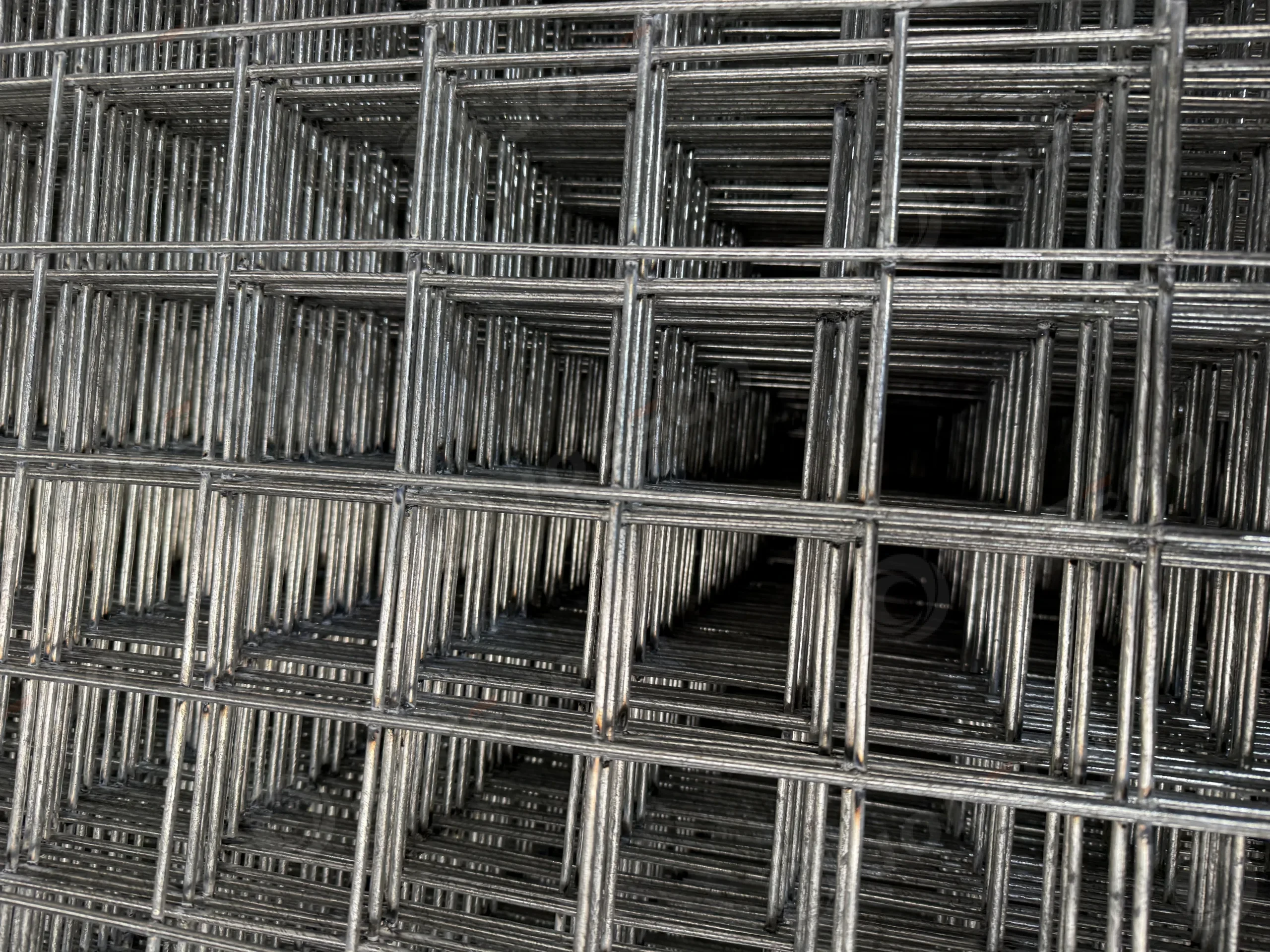
JOESCO barriers were originally engineered as rapid-deployment flood control and earth-retention units. Their core structure consists of a galvanized steel wire mesh container lined with heavy-duty polypropylene geotextile. On their own, these empty units offer zero ballistic protection.
However, when filled with compacted sand, gravel, or engineered soil media, the system transforms. The protective capability stems from fundamental ballistic physics: mass + thickness + energy dissipation. Dense granular materials absorb kinetic energy through particle friction, plastic deformation, and progressive fragmentation of the projectile. This is why a properly filled HESCO wall can perform like a “soft armor” barrier—without being made of steel or ceramic.
Real-World Ballistic Performance: What Can It Stop?
Based on field reports from NATO forces, independent ballistic labs, and manufacturer testing, a standard HESCO unit (filled to 1.2–1.5 meters thickness with dry, well-compacted sand) typically provides reliable protection against:
✅ 7.62×39mm mild steel core rounds (common AK-platform ammunition)
✅ 5.56×45mm NATO FMJ (standard rifle threats)
✅ Handgun rounds up to .44 Magnum
✅ Shrapnel, blast fragments, and low-velocity ricochets
✅ 5.56×45mm NATO FMJ (standard rifle threats)
✅ Handgun rounds up to .44 Magnum
✅ Shrapnel, blast fragments, and low-velocity ricochets
⚠️ Limitations to acknowledge:
❌ Single-layer HESCO walls may not reliably stop .50 BMG (12.7mm) armor-piercing rounds
❌ Sustained automatic fire can compromise structural integrity through material erosion
❌ Penetration risk increases with poor fill quality, inadequate compaction, or weather-induced settling
❌ Single-layer HESCO walls may not reliably stop .50 BMG (12.7mm) armor-piercing rounds
❌ Sustained automatic fire can compromise structural integrity through material erosion
❌ Penetration risk increases with poor fill quality, inadequate compaction, or weather-induced settling
Protection efficacy depends heavily on three variables:
- Fill material: Dry silica sand or graded gravel outperforms clay or organic soils
- Compaction density: Target ≥1.6 g/cm³ for optimal energy absorption
- Wall configuration: Double-layer, staggered layouts eliminate straight-line penetration paths
In high-threat environments, military units often combine JOESCO barriers with supplemental armor plates, overhead fragmentation covers, or reinforced steel framing for layered defense.
Why Choose HESCO If It’s Not “Bulletproof”?
Despite not being a certified ballistic shield, HESCO remains a cornerstone of modern force protection for compelling reasons:
🔹 Rapid deployment: A trained team can assemble and fill a 10-meter wall section in under 2 hours—no heavy machinery required
🔹 Cost efficiency: Significantly lower lifecycle cost versus precast concrete or steel barriers
🔹 Adaptability: Conforms to uneven terrain; modules can be reconfigured or relocated
🔹 Multi-hazard utility: Provides blast mitigation, flood control, and erosion protection in one system
🔹 Logistical simplicity: Ships flat-packed; fill material often sourced locally
🔹 Cost efficiency: Significantly lower lifecycle cost versus precast concrete or steel barriers
🔹 Adaptability: Conforms to uneven terrain; modules can be reconfigured or relocated
🔹 Multi-hazard utility: Provides blast mitigation, flood control, and erosion protection in one system
🔹 Logistical simplicity: Ships flat-packed; fill material often sourced locally
The strategic value lies in positioning HESCO as a flexible, scalable first layer of defense—not a standalone ultimate shield.
Best Practices to Maximize Ballistic Performance
To ensure your HESCO installation delivers expected protection:
- Use optimal fill: Prioritize dry, angular sand (0.5–2mm grain size) or crushed gravel. Avoid moisture-retentive soils.
- Compact rigorously: Mechanically tamp every 15–20cm lift layer to eliminate voids and maximize density.
- Design for redundancy: Overlap units in a staggered “brickwork” pattern; add a second row for high-risk perimeters.
- Protect the liner: Shield geotextile from prolonged UV exposure with tarps or paint to extend service life.
- Inspect regularly: Check for settlement, fabric tears, or water damage quarterly; replenish fill as needed.
For critical assets, consider hybrid solutions: HESCO outer layer + internal ballistic panels, or integration with vehicle barriers and surveillance systems.